<?xml version="1.0" encoding="UTF-8"?>
<feed xmlns="http://www.w3.org/2005/Atom" xml:lang="en-gb">
<link rel="self" type="application/atom+xml" href="http://forum.robosavvy.com/feed.php?f=21&amp;t=6473" />

<title>RoboSavvy Forum</title>
<subtitle>Robosavvy Forum: The largest online community of Humanoid Robot Builders</subtitle>
<link href="http://forum.robosavvy.com/index.php" />
<updated>2011-07-28T15:40:27+01:00</updated>

<author><name><![CDATA[RoboSavvy Forum]]></name></author>
<id>http://forum.robosavvy.com/feed.php?f=21&amp;t=6473</id>
<entry>
<author><name><![CDATA[Zacohk]]></name></author>
<updated>2011-07-28T15:40:27+01:00</updated>
<published>2011-07-28T15:40:27+01:00</published>
<id>http://forum.robosavvy.com/viewtopic.php?t=6473&amp;p=31881#p31881</id>
<link href="http://forum.robosavvy.com/viewtopic.php?t=6473&amp;p=31881#p31881"/>
<title type="html"><![CDATA[I2C – ADC module]]></title>

<content type="html" xml:base="http://forum.robosavvy.com/viewtopic.php?t=6473&amp;p=31881#p31881"><![CDATA[
The Bifferboard has a limited qty of IO. I needed some analog inputs for battery measurement and to connect some cheap analog sensors.<br />The I2C-ADC is a tiny 8-CH Analog-to-Digital Converter, wonderful, from one I2c module I can read 8 analog inputs.<br />I connected this module to 3.3v, GND, SDA, SCL<br />Below code sample will display the value from CHO (pin 1).<br />Device id = 0x48<br /><br /><img src="http://robosavvy.com/Builders/Zaco/I2C-ADC_2.jpg" alt="Image" /><br /><br /><dl class="codebox"><dt>Code: </dt><dd><code><br />#include &lt;stdio&gt;<br />#include &lt;fcntl&gt;<br />#include &lt;stdlib&gt; <br />#include &quot;/usr/include/linux/i2c-dev.h&quot;<br /><br />int main&#40;void&#41; <br />&#123;<br /><br />while &#40;1&#41;&#123;<br />   int fd;<br />   char filename&#91;20&#93;;<br />   char buf&#91;10&#93;;<br />   int value0=0;<br /><br />   sprintf&#40;filename, &quot;/dev/i2c-0&quot;&#41;;<br />   fd = open&#40;filename, O_RDWR&#41;;<br />   if &#40;fd &lt; 0&#41; &#123;<br />      printf&#40;&quot;Error on open\n&quot;&#41;;<br />      exit&#40;1&#41;;<br />   &#125;<br /><br />   if &#40;ioctl&#40;fd, I2C_SLAVE, 0x48&#41; &lt; 0&#41; &#123;<br />      printf&#40;&quot;Error on slave address\n&quot;&#41;;<br />      exit&#40;1&#41;;<br />   &#125;<br /><br /><br />   buf&#91;0&#93; = 0x8C;<br />        write&#40;fd,buf,1&#41;;<br /><br />   // Wait for the measurement<br />   usleep&#40;300000&#41;;<br /><br />   read&#40;fd,buf,2&#41;;<br />   <br />   value0 = buf&#91;0&#93;&lt;&lt;8;<br /><br />   value0 |= buf&#91;0&#93;;<br />   <br /><br />   printf&#40;&quot;Value =%d\n&quot;,value0&#41;;   <br />   close&#40;fd&#41;;<br />&#125;<br />   return 0;   <br />&#125;<br /></code></dd></dl><p>Statistics: Posted by <a href="http://forum.robosavvy.com/memberlist.php?mode=viewprofile&amp;u=1078">Zacohk</a> — Thu Jul 28, 2011 3:40 pm</p><hr />
]]></content>
</entry>
<entry>
<author><name><![CDATA[Zacohk]]></name></author>
<updated>2011-07-28T15:38:05+01:00</updated>
<published>2011-07-28T15:38:05+01:00</published>
<id>http://forum.robosavvy.com/viewtopic.php?t=6473&amp;p=31880#p31880</id>
<link href="http://forum.robosavvy.com/viewtopic.php?t=6473&amp;p=31880#p31880"/>
<title type="html"><![CDATA[Triple axis accelerometer BMA 180]]></title>

<content type="html" xml:base="http://forum.robosavvy.com/viewtopic.php?t=6473&amp;p=31880#p31880"><![CDATA[
Below code simply show x,y,z status.<br />Just connect  3.3v, GND, SDA, SCL<br />Device id = 0x40<br /><img src="http://robosavvy.com/Builders/Zaco/BMA180.jpg" alt="Image" /><br /><br /><br /><dl class="codebox"><dt>Code: </dt><dd><code><br />#include &lt;stdio&gt;<br />#include &lt;fcntl&gt;<br />#include &lt;stdlib&gt; <br />#include &quot;/usr/include/linux/i2c-dev.h&quot;<br />#define BMA180_ID       0x00<br />#define BMA180_ADDR     0x40 //device id<br />#define BMA180_X_ACC    0x02<br />#define BMA180_Y_ACC    0x04<br />#define BMA180_Z_ACC    0x06<br /><br />int main&#40;void&#41; <br />&#123;<br />   int fd;<br />   char filename&#91;20&#93;;<br />        <br />        char data&#91;2&#93;;<br />        int16_t x,y,z;<br /><br />   sprintf&#40;filename, &quot;/dev/i2c-0&quot;&#41;;<br />   fd = open&#40;filename, O_RDWR&#41;;<br />   if &#40;fd &lt; 0&#41; &#123;<br />      printf&#40;&quot;Error on open\n&quot;&#41;;<br />      exit&#40;1&#41;;<br />   &#125;<br /><br />   if &#40;ioctl&#40;fd, I2C_SLAVE, 0x40&#41; &lt;0&gt;&gt;= 2;<br />        x  = *&#40;&#40;int16_t*&#41;data&#41;;<br />        <br />        data&#91;0&#93; = BMA180_Y_ACC;<br />        write&#40;fd, data, 1&#41;;<br />        read&#40;fd, data, 2&#41;;<br />   data&#91;0&#93; &gt;&gt;= 2;<br />        y  = *&#40;&#40;int16_t*&#41;data&#41;;<br />        <br />        data&#91;0&#93; = BMA180_Z_ACC;<br />        write&#40;fd, data, 1&#41;;<br />        read&#40;fd, data, 2&#41;;<br />   data&#91;0&#93; &gt;&gt;= 2;<br />        z  = *&#40;&#40;int16_t*&#41;data&#41;;<br /><br />    <br />       printf &#40;&quot;X: %d Y: %d Z: %d\n&quot;, x/136, y/136, z/136&#41;;<br />       printf&#40;&quot;x: %.1f y: %.1f z: %.1f\n&quot;, x/16384.0f, y/16384.0f, z/16384.0f&#41;; //2^14<br /><br />        <br />&#125;<br />   close&#40;fd&#41;;<br />   return 0;   <br />&#125;<br /></code></dd></dl><p>Statistics: Posted by <a href="http://forum.robosavvy.com/memberlist.php?mode=viewprofile&amp;u=1078">Zacohk</a> — Thu Jul 28, 2011 3:38 pm</p><hr />
]]></content>
</entry>
<entry>
<author><name><![CDATA[Zacohk]]></name></author>
<updated>2011-07-28T15:35:28+01:00</updated>
<published>2011-07-28T15:35:28+01:00</published>
<id>http://forum.robosavvy.com/viewtopic.php?t=6473&amp;p=31879#p31879</id>
<link href="http://forum.robosavvy.com/viewtopic.php?t=6473&amp;p=31879#p31879"/>
<title type="html"><![CDATA[Distance Sensor SRF10]]></title>

<content type="html" xml:base="http://forum.robosavvy.com/viewtopic.php?t=6473&amp;p=31879#p31879"><![CDATA[
It is the smallest i2c distance sensor I found. I connected 5v, Gnd, SDA, SCL<br />Device id = 0x70<br />Below code spit out the distance in CM.<br /><br /><img src="http://robosavvy.com/Builders/Zaco/SRF10.JPG" alt="Image" /><br /><br /><br /><br /><dl class="codebox"><dt>Code: </dt><dd><code><br />#include &lt;stdio&gt;<br />#include &lt;fcntl&gt;<br />#include &lt;stdlib&gt; <br />#include &quot;/usr/include/linux/i2c-dev.h&quot;<br /><br />int main&#40;void&#41; <br />&#123;<br />   int fd;<br />   char filename&#91;20&#93;;<br />   char buf&#91;10&#93;;<br />   int res;<br />   int range=0;<br /><br />   sprintf&#40;filename, &quot;/dev/i2c-0&quot;&#41;;<br />   fd = open&#40;filename, O_RDWR&#41;;<br />   if &#40;fd &lt; 0&#41; &#123;<br />      printf&#40;&quot;Error on open\n&quot;&#41;;<br />      exit&#40;1&#41;;<br />   &#125;<br /><br />   if &#40;ioctl&#40;fd, I2C_SLAVE, 0x70&#41; &lt; 0&#41; &#123;<br />      printf&#40;&quot;Error on slave address\n&quot;&#41;;<br />      exit&#40;1&#41;;<br />   &#125;<br /><br /><br />   buf&#91;0&#93; = 0x00;<br />   buf&#91;1&#93; = 0x51;<br />   if &#40;&#40;write&#40;fd,buf,2&#41;&#41;!=2&#41; &#123;<br />      printf&#40;&quot;Error send the read command\n&quot;&#41;;<br />      exit&#40;1&#41;;<br />   &#125;<br /><br />   // Wait for the measurement<br />   usleep&#40;66000&#41;;<br /><br />   buf&#91;0&#93; = 0x02;<br />   if &#40;&#40;write&#40;fd,buf,1&#41;&#41;!=1&#41; &#123;<br />      printf&#40;&quot;Error on select the Range High Byte\n&quot;&#41;;<br />      exit&#40;1&#41;;<br />   &#125;<br /><br />   if &#40;&#40;read&#40;fd,buf,1&#41;&#41;!=1&#41; &#123;<br />      printf&#40;&quot;Error on read the Range High Byte\n&quot;&#41;;<br />      exit&#40;1&#41;;<br />   &#125;<br />   range = buf&#91;0&#93;&lt;&lt;8;<br /><br />   buf&#91;0&#93; = 0x03;<br />   if &#40;&#40;write&#40;fd,buf,1&#41;&#41;!=1&#41; &#123;<br />      printf&#40;&quot;Error on select the Range Low Byte\n&quot;&#41;;<br />      exit&#40;1&#41;;<br />   &#125;<br /><br />   if &#40;&#40;read&#40;fd,buf,1&#41;&#41;!=1&#41; &#123;<br />      printf&#40;&quot;Error on read the Range Low Byte\n&quot;&#41;;<br />      exit&#40;1&#41;;<br />   &#125;<br />   range |= buf&#91;0&#93;;<br /><br />   printf&#40;&quot;Range=%d cm\n&quot;,range&#41;;   <br />   close&#40;fd&#41;;<br /><br />   return 0;   <br />&#125;<br /><br /></code></dd></dl><p>Statistics: Posted by <a href="http://forum.robosavvy.com/memberlist.php?mode=viewprofile&amp;u=1078">Zacohk</a> — Thu Jul 28, 2011 3:35 pm</p><hr />
]]></content>
</entry>
<entry>
<author><name><![CDATA[Zacohk]]></name></author>
<updated>2011-07-28T15:32:14+01:00</updated>
<published>2011-07-28T15:32:14+01:00</published>
<id>http://forum.robosavvy.com/viewtopic.php?t=6473&amp;p=31878#p31878</id>
<link href="http://forum.robosavvy.com/viewtopic.php?t=6473&amp;p=31878#p31878"/>
<title type="html"><![CDATA[Reading I2c Sensors - preparation]]></title>

<content type="html" xml:base="http://forum.robosavvy.com/viewtopic.php?t=6473&amp;p=31878#p31878"><![CDATA[
I took some time rewriting my server and other functions from Python to C. I found that Python was not fast enough on this board and I had some difficulties with some protocols.<br /><br />I wanted to collect a maximum of environment data and display them to the web control page.  ( a next step will be to use these  data in a autonomous navigation program).<br /><br /><img src="http://robosavvy.com/Builders/Zaco/Control.jpg" alt="Image" /><br /><br />I gathered a batch of small I2c sensors and connected them in serial to the Bifferboard IO (pin 9 &amp;12).<br /><br />Following posts give  details and code samples showing how to configure and read the I2c sensors with a  Bifferboard running a Debian Squeeze distro with relevant patches (there is a link on my blog to download it).<br /><br /><br /><span style="font-weight: bold">Bifferboard preparation:</span> <br /><br />Compile and install the i2c tools.<br /><br />Then, add the following command in a startup script&#058;<br /><br />modprobe rdc321x_gpio<br />modprobe i2c-algo-bit<br />modprobe i2c-gpio<br />modprobe i2c-gpio-custom bus0=0,12,9       // I2c Pin <br />modprobe i2c-dev<br /><br />In this configuration Pin 12 = SDA, Pin 9 = SCL<br /><br /><img src="http://robosavvy.com/Builders/Zaco/Bifferboard%20IO.jpg" alt="Image" /><br /><br />All the following codes are compiled on the Bifferboard with GCC<p>Statistics: Posted by <a href="http://forum.robosavvy.com/memberlist.php?mode=viewprofile&amp;u=1078">Zacohk</a> — Thu Jul 28, 2011 3:32 pm</p><hr />
]]></content>
</entry>
<entry>
<author><name><![CDATA[Bullit]]></name></author>
<updated>2011-03-28T04:27:27+01:00</updated>
<published>2011-03-28T04:27:27+01:00</published>
<id>http://forum.robosavvy.com/viewtopic.php?t=6473&amp;p=30654#p30654</id>
<link href="http://forum.robosavvy.com/viewtopic.php?t=6473&amp;p=30654#p30654"/>
<title type="html"><![CDATA[BIFFERBOARD + VSTONE NANO]]></title>

<content type="html" xml:base="http://forum.robosavvy.com/viewtopic.php?t=6473&amp;p=30654#p30654"><![CDATA[
The newer Robotis Darwin-OP source includes a mjpeg_streamer interface for look up table (lut) generation to an ini file.  The follower class can load specific color entries from the ini file.<br /><br />here's another link to the Darwin-OP source for reference:<br />  <a href="http://darwinop.svn.sourceforge.net/viewvc/darwinop/trunk/darwin/" class="postlink">http://darwinop.svn.sourceforge.net/viewvc/darwinop/trunk/darwin/</a><p>Statistics: Posted by <a href="http://forum.robosavvy.com/memberlist.php?mode=viewprofile&amp;u=173">Bullit</a> — Mon Mar 28, 2011 4:27 am</p><hr />
]]></content>
</entry>
<entry>
<author><name><![CDATA[billyzelsnack]]></name></author>
<updated>2011-03-26T18:55:03+01:00</updated>
<published>2011-03-26T18:55:03+01:00</published>
<id>http://forum.robosavvy.com/viewtopic.php?t=6473&amp;p=30649#p30649</id>
<link href="http://forum.robosavvy.com/viewtopic.php?t=6473&amp;p=30649#p30649"/>
<title type="html"><![CDATA[BIFFERBOARD + VSTONE NANO]]></title>

<content type="html" xml:base="http://forum.robosavvy.com/viewtopic.php?t=6473&amp;p=30649#p30649"><![CDATA[
camlutgen is my implementation of a generator of the type of LUT the Darwin team is using for their vision. I don't think the Darwin source contains their LUT generator, though maybe I missed it.<br /><br />camlutgen is a Qt app. Qt is cross-platform, but Qt does not have cross-platform support for webcams. The code only has an implementation for webcams under Linux.<br /><br />Also. camlutgen is only a tool to generate a LUT. You would not run it on the bifferboard. You would use it to generate a LUT that would be used by some other code on the bifferboard.<p>Statistics: Posted by <a href="http://forum.robosavvy.com/memberlist.php?mode=viewprofile&amp;u=459">billyzelsnack</a> — Sat Mar 26, 2011 6:55 pm</p><hr />
]]></content>
</entry>
<entry>
<author><name><![CDATA[Zacohk]]></name></author>
<updated>2011-03-26T16:03:43+01:00</updated>
<published>2011-03-26T16:03:43+01:00</published>
<id>http://forum.robosavvy.com/viewtopic.php?t=6473&amp;p=30647#p30647</id>
<link href="http://forum.robosavvy.com/viewtopic.php?t=6473&amp;p=30647#p30647"/>
<title type="html"><![CDATA[BIFFERBOARD + VSTONE NANO]]></title>

<content type="html" xml:base="http://forum.robosavvy.com/viewtopic.php?t=6473&amp;p=30647#p30647"><![CDATA[
Thanks for these advices Billy and Pedro. I am studying these options and will post my progress.<br />For the moment I don’t see  how to compile the Darwin YUV LUT generator (<br />camlutgen) or the Opencv library on the Bifferboard, any tips would be welcome.<p>Statistics: Posted by <a href="http://forum.robosavvy.com/memberlist.php?mode=viewprofile&amp;u=1078">Zacohk</a> — Sat Mar 26, 2011 4:03 pm</p><hr />
]]></content>
</entry>
<entry>
<author><name><![CDATA[PedroR]]></name></author>
<updated>2011-03-22T17:28:30+01:00</updated>
<published>2011-03-22T17:28:30+01:00</published>
<id>http://forum.robosavvy.com/viewtopic.php?t=6473&amp;p=30598#p30598</id>
<link href="http://forum.robosavvy.com/viewtopic.php?t=6473&amp;p=30598#p30598"/>
<title type="html"><![CDATA[BIFFERBOARD + VSTONE NANO]]></title>

<content type="html" xml:base="http://forum.robosavvy.com/viewtopic.php?t=6473&amp;p=30598#p30598"><![CDATA[
ah one last comment, we'll also be getting another LCD (a larger one with 3.2&quot;) which has a resistive touchscreen. The processor is a different - PICASO - but works in the same manner as the GOLDELOX. The PICASO just has more horsepower.<br /><br />From reading your posts 3.2&quot; may be a bit large for your robot but here are is the link in any case: <!-- m --><a class="postlink" href="http://www.4dsystems.com.au/prod.php?id=114">http://www.4dsystems.com.au/prod.php?id=114</a><!-- m --><br /><br />Regards<br />Pedro<p>Statistics: Posted by <a href="http://forum.robosavvy.com/memberlist.php?mode=viewprofile&amp;u=1061">PedroR</a> — Tue Mar 22, 2011 5:28 pm</p><hr />
]]></content>
</entry>
<entry>
<author><name><![CDATA[PedroR]]></name></author>
<updated>2011-03-22T16:06:50+01:00</updated>
<published>2011-03-22T16:06:50+01:00</published>
<id>http://forum.robosavvy.com/viewtopic.php?t=6473&amp;p=30594#p30594</id>
<link href="http://forum.robosavvy.com/viewtopic.php?t=6473&amp;p=30594#p30594"/>
<title type="html"><![CDATA[BIFFERBOARD + VSTONE NANO]]></title>

<content type="html" xml:base="http://forum.robosavvy.com/viewtopic.php?t=6473&amp;p=30594#p30594"><![CDATA[
Hi Zahcok<br /><br />Allow me to jump in with a couple of suggestions.<br /><br />Limor pointed out your post to me which, after reading it, is definitely very interesting.<br /><br />We'll be receiving here on RoboSavvy some new products in the next weeks which I thought might be interesting in advancing your design.<br /><br />One is a 1.44&quot; LCD <!-- m --><a class="postlink" href="http://www.4dsystems.com.au/prod.php?id=120">http://www.4dsystems.com.au/prod.php?id=120</a><!-- m --> <br />Despite the small size it's powered by a GOLDELOX chip which is very powerful and can do quite a lot.<br />Check out the GFX or SGC section on the page. The module can work over serial (not sure about I2C) but the onboard processor can be programmed and operate stand alone; maybe even co-process some of the tasks on the robot.<br />I know it is capable of doing for example sound output and has some GPIO pins usable if you choose to program it in GFX mode.<br /><br /><br />The other one is a Serial JPEG camera <!-- m --><a class="postlink" href="http://www.4dsystems.com.au/prod.php?id=75">http://www.4dsystems.com.au/prod.php?id=75</a><!-- m --><br />It would release a USB port from your webcam but the main reason for this suggestion is that you mentioned OpenCV.<br /><br />If you want to do a simple color tracking mechanism (such as the one suggested billyzelsnack), it's quite easy to do that instructing the CAM to take small resolution frames and looking for BLOBs pixel by pixel.<br />I think the Bifferboard is of implementing such an algorithm which is fairly simple.<br />Also, since the CAM and data travels over the Serial line all the overhead of the USB stack is eliminated, releasing some processing power.<br />One sample algorithm can be found here <!-- m --><a class="postlink" href="http://geekblog.nl/entry/24">http://geekblog.nl/entry/24</a><!-- m --><br /><br />The CAM can also take higher resolution JPEGs should you wish to do simple streaming.<br /><br />Pedro.<p>Statistics: Posted by <a href="http://forum.robosavvy.com/memberlist.php?mode=viewprofile&amp;u=1061">PedroR</a> — Tue Mar 22, 2011 4:06 pm</p><hr />
]]></content>
</entry>
<entry>
<author><name><![CDATA[billyzelsnack]]></name></author>
<updated>2011-03-19T20:03:09+01:00</updated>
<published>2011-03-19T20:03:09+01:00</published>
<id>http://forum.robosavvy.com/viewtopic.php?t=6473&amp;p=30564#p30564</id>
<link href="http://forum.robosavvy.com/viewtopic.php?t=6473&amp;p=30564#p30564"/>
<title type="html"><![CDATA[BIFFERBOARD + VSTONE NANO]]></title>

<content type="html" xml:base="http://forum.robosavvy.com/viewtopic.php?t=6473&amp;p=30564#p30564"><![CDATA[
<blockquote><div><cite>Zacohk wrote:</cite><br />- Color/blob tracking:<br />I am collecting some info. I don’t expect to run OpenCV on a 150Mhz board but I wonder if some pure C color tracking program could work. I am studying this project for example:<br /><a href="http://negativeacknowledge.com/2009/05/robot2-an-arm-based-colour-tracking-robot/" class="postlink">http://negativeacknowledge.com/2009/05/robot2-an-arm-based-colour-tracking-robot/</a><br /></div></blockquote><br /><br />The LUT technique that the Darwin-OP is using is pretty fast and quite robust. I have a video about a tool I made here.. <!-- m --><a class="postlink" href="http://www.youtube.com/watch?v=4M5epYU0kdc">http://www.youtube.com/watch?v=4M5epYU0kdc</a><!-- m --><br /><br />The basic jist is that you take the YUV values for a pixel and you use it to index into a LUT that gives you back a quantized color for the pixel. You end up with a frame with the background masked out and only a few color values to deal with. From this data it is much easier to robustly track an object.<p>Statistics: Posted by <a href="http://forum.robosavvy.com/memberlist.php?mode=viewprofile&amp;u=459">billyzelsnack</a> — Sat Mar 19, 2011 8:03 pm</p><hr />
]]></content>
</entry>
<entry>
<author><name><![CDATA[Zacohk]]></name></author>
<updated>2011-03-19T16:20:29+01:00</updated>
<published>2011-03-19T16:20:29+01:00</published>
<id>http://forum.robosavvy.com/viewtopic.php?t=6473&amp;p=30562#p30562</id>
<link href="http://forum.robosavvy.com/viewtopic.php?t=6473&amp;p=30562#p30562"/>
<title type="html"><![CDATA[BIFFERBOARD + VSTONE NANO]]></title>

<content type="html" xml:base="http://forum.robosavvy.com/viewtopic.php?t=6473&amp;p=30562#p30562"><![CDATA[
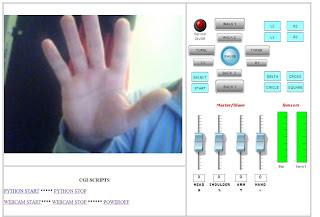
Thanks Limor,<br /><br />I am currently working on properly  installing a SRF-10 distance sensor and BMA180 accelerometer. I have some code working (in Python and C) and my concerns  now are to decide where to install the SRF-10 (I will need to either make a new head or a new chest) and how to integrate these measurement to some (usefull) robot control (reading is quite slow in Python so I seriously need  to improve my C/C++)<br /><br /><br />The GUI control is board is in Flash, it is quite simple: when pressed, a button send a string (for example “SON” when the button Servo ON/OFF is pressed once) to a socket server, in Python, running on the Bifferboard who then send the according serial command to the NANO controller (in this case W2009f60100\r\n which turn the servos on).<br /><br />The master slave slides generate some variables that are , in the same way, directly converted to some servo positions.<br /><br />These slides are more for debugging and testing the connection and respond now. My plan is to do some master slave control with some potentiometers or sensors (connected to an Arduino for which Flash  communication is easy to setup).<br /><br />The Flash (socket) also receive and display the variables (Battery level, I2c variable)  and strings from another similar Bifferboard Python server (I am redoing it).<br /><br />The green button on the right of  the Speech Synthetiser text box, send the content of this box to the server which trigger flite and read it (cmd = 'flite -t %r &amp;' %data2) on the Nano.<br /><br />The  Button Music start a webradio, I need to add a button to stop it .....<br /><br />The Python Socket server and the Flash Adobe GUI can be downloaded here:<br /><br />PYSERVER Link<br /><a href="https://docs.google.com/leaf?id=0B6rYc4n12uHTMjVhZDc4MzgtMDQ3YS00YzBkLWJmMDQtNGY4MWRmYWYzNWYy&amp;hl=en&amp;authkey=CPGYrIYL" class="postlink">https://docs.google.com/leaf?id=0B6rYc4n12uHTMjVhZDc4MzgtMDQ3YS00YzBkLWJmMDQtNGY4MWRmYWYzNWYy&amp;hl=en&amp;authkey=CPGYrIYL</a><br /><br /><br />NANO FLASH Link<br /><a href="https://docs.google.com/leaf?id=0B6rYc4n12uHTNWE2M2EzODUtMTM1MS00MTY2LWIxZDEtMzU3ZTdhNmQ4ZGY2&amp;hl=en&amp;authkey=CIO5y78M" class="postlink">https://docs.google.com/leaf?id=0B6rYc4n12uHTNWE2M2EzODUtMTM1MS00MTY2LWIxZDEtMzU3ZTdhNmQ4ZGY2&amp;hl=en&amp;authkey=CIO5y78M</a><br /><br /><br />Concerning some other tasks:<br /><br />- Speech recognition (voice control):<br />I am still trying to install Cvoicecontrol : <br /><a href="http://www.kiecza.net/daniel/linux/cvoicecontrol/index-1.html" class="postlink">http://www.kiecza.net/daniel/linux/cvoicecontrol/index-1.html</a><br /><br />I did succeed, once, to install it on my Bifferboard running Debian Lenny but I had some mic calibration issues.<br />I didn’t succeed yet to install this program on Debian Squeeze.<br /><br />- Color/blob tracking:<br />I am collecting some info. I don’t expect to run OpenCV on a 150Mhz board but I wonder if some pure C color tracking program could work. I am studying this project for example:<br /><a href="http://negativeacknowledge.com/2009/05/robot2-an-arm-based-colour-tracking-robot/" class="postlink">http://negativeacknowledge.com/2009/05/robot2-an-arm-based-colour-tracking-robot/</a><br /><br /> - Oled i2c display<br />Still sold out for the moment (this nice little color 128 x 64 oled I2c display).<p>Statistics: Posted by <a href="http://forum.robosavvy.com/memberlist.php?mode=viewprofile&amp;u=1078">Zacohk</a> — Sat Mar 19, 2011 4:20 pm</p><hr />
]]></content>
</entry>
<entry>
<author><name><![CDATA[limor]]></name></author>
<updated>2011-03-17T14:48:35+01:00</updated>
<published>2011-03-17T14:48:35+01:00</published>
<id>http://forum.robosavvy.com/viewtopic.php?t=6473&amp;p=30519#p30519</id>
<link href="http://forum.robosavvy.com/viewtopic.php?t=6473&amp;p=30519#p30519"/>
<title type="html"><![CDATA[BIFFERBOARD + VSTONE NANO]]></title>

<content type="html" xml:base="http://forum.robosavvy.com/viewtopic.php?t=6473&amp;p=30519#p30519"><![CDATA[
Hi Zaco,<br /><br />I love your Bifferboard humanoid project and was wondering if you have done much progress the past month.<br /><br />Here's an extract from your blog's todo list:<br /><br /><blockquote class="uncited"><div><br />Build Debian kernel &amp; rootf : (done) Debian Squeeze with headers. Linux 2.6.32.2<br />Wlan (done)<br />Remote motions control (done)<br />Remote master slave control : (done)<br />Video streaming - 2 ways : (done)<br />Vision/Blob recognitions (not started)<br />Sound streaming - 2 ways (wip) - can play stream, can record sound<br />Speech Synthesis (done) - flite working well, espeak is choppy but still usable<br />Speech Recognition (wip)<br />Remote Sensors monitoring (done) Battery level, accelerometer, distance, temperature<br />Lcd usb display (done) - hacked 1.5&quot; key chain<br />Oled i2c display (wip)<br />Auto charging (not started)<br /></div></blockquote><br /><br />Can you please expand a bit more on the status of items in your task list and also maybe share the source code for the video broadcast and remote video display and control GUI?<br /><br /><img src="http://lh4.googleusercontent.com/-z-b5Z9F98z0/TWkFLgfIMlI/AAAAAAAAABs/8lhI0St0WM0/s320/Screen1.jpg" alt="Image" /><p>Statistics: Posted by <a href="http://forum.robosavvy.com/memberlist.php?mode=viewprofile&amp;u=2">limor</a> — Thu Mar 17, 2011 2:48 pm</p><hr />
]]></content>
</entry>
<entry>
<author><name><![CDATA[Zacohk]]></name></author>
<updated>2011-02-26T16:19:03+01:00</updated>
<published>2011-02-26T16:19:03+01:00</published>
<id>http://forum.robosavvy.com/viewtopic.php?t=6473&amp;p=30349#p30349</id>
<link href="http://forum.robosavvy.com/viewtopic.php?t=6473&amp;p=30349#p30349"/>
<title type="html"><![CDATA[BIFFERBOARD + VSTONE NANO]]></title>

<content type="html" xml:base="http://forum.robosavvy.com/viewtopic.php?t=6473&amp;p=30349#p30349"><![CDATA[
My Debian distro (Squeeze) compiled with all modules + my scripts and the kernel can be downloaded from my blog:<br /><br /><!-- m --><a class="postlink" href="http://microrobotic.blogspot.com/">http://microrobotic.blogspot.com/</a><!-- m --><p>Statistics: Posted by <a href="http://forum.robosavvy.com/memberlist.php?mode=viewprofile&amp;u=1078">Zacohk</a> — Sat Feb 26, 2011 4:19 pm</p><hr />
]]></content>
</entry>
<entry>
<author><name><![CDATA[Zacohk]]></name></author>
<updated>2011-02-26T16:10:36+01:00</updated>
<published>2011-02-26T16:10:36+01:00</published>
<id>http://forum.robosavvy.com/viewtopic.php?t=6473&amp;p=30348#p30348</id>
<link href="http://forum.robosavvy.com/viewtopic.php?t=6473&amp;p=30348#p30348"/>
<title type="html"><![CDATA[BIFFERBOARD + VSTONE NANO]]></title>

<content type="html" xml:base="http://forum.robosavvy.com/viewtopic.php?t=6473&amp;p=30348#p30348"><![CDATA[
I order to play Flite (Text to Speech), audio file or stream I added the USB audio adapter &quot;Music Fairy&quot; pictured below. It has the smallest pcb. <br />I added 2 x 0.25 W speakers in the Nano hands.<br /><br /><img src="http://robosavvy.com/Builders/Zaco/DSC01103.JPG" alt="Image" /><br /><img src="http://robosavvy.com/Builders/Zaco/DSC01095.JPG" alt="Image" /><br /><img src="http://robosavvy.com/Builders/Zaco/DSC01098.JPG" alt="Image" /><p>Statistics: Posted by <a href="http://forum.robosavvy.com/memberlist.php?mode=viewprofile&amp;u=1078">Zacohk</a> — Sat Feb 26, 2011 4:10 pm</p><hr />
]]></content>
</entry>
<entry>
<author><name><![CDATA[Zacohk]]></name></author>
<updated>2011-02-07T05:46:03+01:00</updated>
<published>2011-02-07T05:46:03+01:00</published>
<id>http://forum.robosavvy.com/viewtopic.php?t=6473&amp;p=30095#p30095</id>
<link href="http://forum.robosavvy.com/viewtopic.php?t=6473&amp;p=30095#p30095"/>
<title type="html"><![CDATA[BIFFERBOARD + VSTONE NANO]]></title>

<content type="html" xml:base="http://forum.robosavvy.com/viewtopic.php?t=6473&amp;p=30095#p30095"><![CDATA[
It is a Vstone Robovie Nano.<br /><br />A neat little bot, with parallel leg mechanism and cheap servos.<br /><br />I also choose this platform because the controller serial communication protocol is easy and  well documented (well ...in Japanese! but Google translate helped a lot).<br />For examples:<br />To start a motion: send W 2009e2 01 00<br />To request the battery voltage: send R 2009dc 04<br />To control servo 246 (ec) position : send W 2009ec 7f 80 00 ff<p>Statistics: Posted by <a href="http://forum.robosavvy.com/memberlist.php?mode=viewprofile&amp;u=1078">Zacohk</a> — Mon Feb 07, 2011 5:46 am</p><hr />
]]></content>
</entry>
</feed>