<?xml version="1.0" encoding="UTF-8"?>
<feed xmlns="http://www.w3.org/2005/Atom" xml:lang="en-gb">
<link rel="self" type="application/atom+xml" href="http://forum.robosavvy.com/feed.php?f=21&amp;t=7164" />

<title>RoboSavvy Forum</title>
<subtitle>Robosavvy Forum: The largest online community of Humanoid Robot Builders</subtitle>
<link href="http://forum.robosavvy.com/index.php" />
<updated>2012-08-15T16:24:05+01:00</updated>

<author><name><![CDATA[RoboSavvy Forum]]></name></author>
<id>http://forum.robosavvy.com/feed.php?f=21&amp;t=7164</id>
<entry>
<author><name><![CDATA[limor]]></name></author>
<updated>2012-06-24T21:55:47+01:00</updated>
<published>2012-06-24T21:55:47+01:00</published>
<id>http://forum.robosavvy.com/viewtopic.php?t=7164&amp;p=34652#p34652</id>
<link href="http://forum.robosavvy.com/viewtopic.php?t=7164&amp;p=34652#p34652"/>
<title type="html"><![CDATA[29GBP / 34EUR / 43USD embedded linux, 320Mhz, wifi-N]]></title>

<content type="html" xml:base="http://forum.robosavvy.com/viewtopic.php?t=7164&amp;p=34652#p34652"><![CDATA[
btw: If you haven't yet played with it, the ROS.org system is not bad as a framework for robot control.<br /><br /><br />the ROS framework provides a clean way of viewing a complex robot system as individual services. each node in a ROS system provides services and sends messages. This may be seem like an overkill for a simple robot such as RoboBuilder but if you add embedded linux and camera then using ROS allows behavior creation to be a piece of cake. (see <a href="http://www.cs.washington.edu/education/courses/cse466/11au/calendar/ros_cc_1_intro-jrsedit.pdf" class="postlink">intro to ROS)</a><p>Statistics: Posted by <a href="http://forum.robosavvy.com/memberlist.php?mode=viewprofile&amp;u=2">limor</a> — Sun Jun 24, 2012 9:55 pm</p><hr />
]]></content>
</entry>
<entry>
<author><name><![CDATA[PaulL]]></name></author>
<updated>2012-06-24T04:09:51+01:00</updated>
<published>2012-06-24T04:09:51+01:00</published>
<id>http://forum.robosavvy.com/viewtopic.php?t=7164&amp;p=34649#p34649</id>
<link href="http://forum.robosavvy.com/viewtopic.php?t=7164&amp;p=34649#p34649"/>
<title type="html"><![CDATA[29GBP / 34EUR / 43USD embedded linux, 320Mhz, wifi-N]]></title>

<content type="html" xml:base="http://forum.robosavvy.com/viewtopic.php?t=7164&amp;p=34649#p34649"><![CDATA[
Hi Limor, Just noticed this post via another...<br /><br /><blockquote><div><cite>limor wrote:</cite><br />This is the only way forward for many reasons<br /></div></blockquote><br /><br />I could not agree more, and not just in the context of robotics, but in many embedded versus PC scenarios. There is a fact that few seem to want to acknowledge: the PC as a platform is ubiquitous, and as such, is in itself a standardized hardware platform, one that can be applied to embedded applications. <br /><br />Embedded processors (PIC, Atmel, etc) support a world of per-application software development. Using a PC in what once was an embedded application changes things: software is suddenly capable of being repurposed, enhanced, and expanded much more easily. Compatibility and communications with other systems improves dramatically. Access to useful things like databases becomes trivial, higher level programming languages result in greater levels of productivity. <br /><br />If you build custom hardware such as proprietary embedded controllers, you'll fight tooth and nail to stake your claim as time marches on, but if you're a software developer (and hardware doesn't do squat without software), you'll find a much more powerful and compatible world in a PC-based controller.<br /><br /><blockquote class="uncited"><div><br />- The fun in this hobby is about innovation and cutting edge technology.<br /></div></blockquote><br /><br />YUP! Definitely agree. As much horsepower (CPU speed, instructions per clock cycle, ram, etc) as I can pack on my bot's back, the better! <img src="http://forum.robosavvy.com/images/smilies/icon_smile.gif" alt=":)" title="Smile" /><br /><br /><blockquote class="uncited"><div><br />- PIC and Atmega have had their run as robot brains.<br /></div></blockquote><br /><br />Absolutely agree. It's nice to have a base to start with, but at some point, controllers had to do more than just move servos. <img src="http://forum.robosavvy.com/images/smilies/icon_smile.gif" alt=":)" title="Smile" /> An oversimplification, but point being that the trend was fairly obvious: start with an embedded controller (MRC-3024 or whatever), and eventually bluetooth it to a PC, and then finally realize one can slap a PC on the bot instead. <img src="http://forum.robosavvy.com/images/smilies/icon_wink.gif" alt=";)" title="Wink" /><br /><br /><blockquote class="uncited"><div><br />They are great at doing real-time stuff and digesting loads of sensor input but if you take the <a href="http://heanet.dl.sourceforge.net/project/darwinop/Tutorials/DARwIn-OP_UPenn_Tutorial.pdf" class="postlink">DARwIn</a> software framework as a glimpse of where the future is heading, then the small microprocessors have a minor role in that future. DARwIn runs on linux with 10x the megaherz of an atmega.<br /></div></blockquote><br /><br />Yes, embedded controllers DO have a place, but it is a small place that consists of otherwise CPU-hungry tasks (the &quot;in hardware&quot; versus &quot;in software&quot; problem). IMHO, high level control software doesn't belong in an embedded processor. It can be (and has been) done to some extent, but there's a better way. <img src="http://forum.robosavvy.com/images/smilies/icon_wink.gif" alt=";)" title="Wink" /><br /><br />There is a world that parallels hobby robotics more than anyone might realize: industrial automation. There are a number of big players in this billion dollar industry, some of which have been doing what they do (ex: embedded controllers running &quot;ladder logic&quot;) for some time now. A bot with over a dozen servos walking around and looking at things with vision processing code (and many other types of sensors) is representative of industrial systems that cost MANY times more than such bots do. Software-wise, what we're doing is functionally no different than what big companies like Omron, Allen Bradley, Siemens, and Cognex have been doing. Clearly, there are differences in the hardware itself, but the functional aspects of software are the same, ex: move this to there, check some sensor, do something else, continue, etc.<br /><br />There is a reason as to why what we want from our bots is often not easy to come by: many engineers have been developing control systems for decades, and they STILL haven't developed a standardized approach to control system software, or even hardware for that matter. Some claim standardization on one aspect or another, but step out onto any production floor and you'll see a number of &quot;standards&quot; in action - a potpouri of hardware and software brutally hammered into something that serves a singular purpose (production), usually at great cost, particularly when the word &quot;integration&quot; (read, connecting two incompatible systems) is used in the design meetings.<br /><br />My point is, if someone designs a control system flexible enough to easily run any bot hardware configuration with n desired features, that person will surely shake up more than just the bot world. <img src="http://forum.robosavvy.com/images/smilies/icon_wink.gif" alt=";)" title="Wink" /> And, I have a sneaking suspicion that the way to do that is with PC-based controller hardware. <img src="http://forum.robosavvy.com/images/smilies/icon_wink.gif" alt=";)" title="Wink" /><br /><br />Take Care,<br />Paul<p>Statistics: Posted by <a href="http://forum.robosavvy.com/memberlist.php?mode=viewprofile&amp;u=741">PaulL</a> — Sun Jun 24, 2012 4:09 am</p><hr />
]]></content>
</entry>
<entry>
<author><name><![CDATA[l3v3rz]]></name></author>
<updated>2012-08-15T16:24:05+01:00</updated>
<published>2012-06-23T11:44:54+01:00</published>
<id>http://forum.robosavvy.com/viewtopic.php?t=7164&amp;p=34638#p34638</id>
<link href="http://forum.robosavvy.com/viewtopic.php?t=7164&amp;p=34638#p34638"/>
<title type="html"><![CDATA[29GBP / 34EUR / 43USD embedded linux, 320Mhz, wifi-N]]></title>

<content type="html" xml:base="http://forum.robosavvy.com/viewtopic.php?t=7164&amp;p=34638#p34638"><![CDATA[
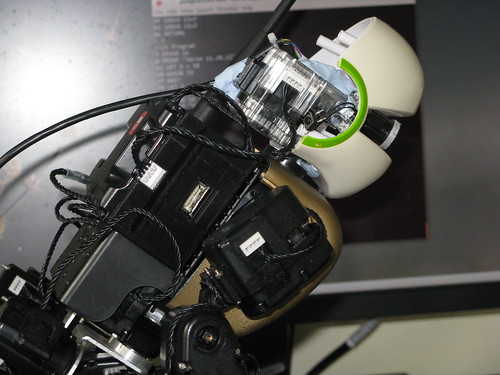
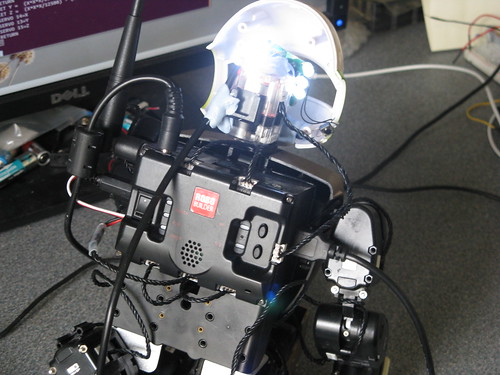
Thought I'd give an update on progress.<br /><br />With help from robosavvy I have the board communicating with the Robobuilder RBC unit - sat inside their 3D printed custom back. I have mjpg_streamer running with a Microsoft webcam attached (pictured is  a different cam I managed to fry first )  I also have my own Basic (<!-- m --><a class="postlink" href="http://code.google.com/p/robobuilderlib/wiki/Omnima">http://code.google.com/p/robobuilderlib/wiki/Omnima</a><!-- m -->) compiled and running controlling the robot. All works fine.  I also have a couple of example programs that control the robot head running in basic using a helper app that converts the jpeg file into a list of numbers for easy importing to basic.<br /><br />Here's a picture of robobuilder with head, camera. The omnima card sits in the modfied RBC on the back - you can see the USB socket. Will sort some video soon.<br /><br /><img src="http://farm8.staticflickr.com/7275/7424758484_57ffe56fae.jpg" alt="Image" /> <img src="http://farm8.staticflickr.com/7263/7424758140_12e1c6a072.jpg" alt="Image" /><p>Statistics: Posted by <a href="http://forum.robosavvy.com/memberlist.php?mode=viewprofile&amp;u=1101">l3v3rz</a> — Sat Jun 23, 2012 11:44 am</p><hr />
]]></content>
</entry>
<entry>
<author><name><![CDATA[gclaudiu]]></name></author>
<updated>2011-12-27T02:17:14+01:00</updated>
<published>2011-12-27T02:17:14+01:00</published>
<id>http://forum.robosavvy.com/viewtopic.php?t=7164&amp;p=33324#p33324</id>
<link href="http://forum.robosavvy.com/viewtopic.php?t=7164&amp;p=33324#p33324"/>
<title type="html"><![CDATA[GPIO LED pins?]]></title>

<content type="html" xml:base="http://forum.robosavvy.com/viewtopic.php?t=7164&amp;p=33324#p33324"><![CDATA[
Merry Christmas to all!<br /><br />Just wanted to share on my experience with this board: I did play a bit with the board and using the stock firmware (got it this month) can go to 20 fps @ 640x480 using Logitech 210 webcam and removing the &quot;-y&quot; with CPU bellow 50% (using &quot;-y&quot; CPU will go very high even at 320x240). <br /><br /><dl class="codebox"><dt>Code: </dt><dd><code>mjpg_streamer -i &quot;input_uvc.so -d /dev/video0 --resolution 640x480 --fps 20&quot; -o &quot;output_http.so -w /webcam_www/&quot;</code></dd></dl><br /><br />Also, did you guys considered using one of the 3 GPIO LED for RESET? I mean, if you want to use this as a solution for live firmware update for an arduino board, can install &quot;ser2net&quot; (which works pretty well on OpenWRT), use one GPIO LED as DTR (RESET) and another one to enable the serial link once the system is up and running...<br /><br />Anyway, is a lovely board, wish was just a little bit smaller and there were some GPIO pins available. <br /><br />Happy holidays!<p>Statistics: Posted by <a href="http://forum.robosavvy.com/memberlist.php?mode=viewprofile&amp;u=2450">gclaudiu</a> — Tue Dec 27, 2011 2:17 am</p><hr />
]]></content>
</entry>
<entry>
<author><name><![CDATA[PedroR]]></name></author>
<updated>2011-12-21T19:24:27+01:00</updated>
<published>2011-12-21T19:24:27+01:00</published>
<id>http://forum.robosavvy.com/viewtopic.php?t=7164&amp;p=33303#p33303</id>
<link href="http://forum.robosavvy.com/viewtopic.php?t=7164&amp;p=33303#p33303"/>
<title type="html"><![CDATA[29GBP / 34EUR / 43USD embedded linux, 320Mhz, wifi-N]]></title>

<content type="html" xml:base="http://forum.robosavvy.com/viewtopic.php?t=7164&amp;p=33303#p33303"><![CDATA[
Hi all<br /><br />We're happy to announce we've compiled a number of resources for the Omnima board that should consilidate all the information about operating the board:<br /><br />- <span style="text-decoration: underline">Developer Notes for the MiniEMBWiFi board</span> are now available for donwload here <!-- m --><a class="postlink" href="http://robosavvy.com/RoboSavvyPages/Omnima/MiniEMBWiFi_DevelopperNotes-Mar11.pdf">http://robosavvy.com/RoboSavvyPages/Omn ... -Mar11.pdf</a><!-- m --><br /><br />These include very useful information such as the <span style="font-weight: bold">Pinout of the Serial port connector </span>and <span style="font-weight: bold">How to Install a new Firmware</span> on the board.<br /><br />- <span style="text-decoration: underline">Pre Compiled Firmware based on OpenWRT</span> (including Luci): <!-- m --><a class="postlink" href="http://robosavvy.com/RoboSavvyPages/Omnima/MiniEMBWiFi_Firmwares/openwrt-ramips-rt305x-omni-emb-squashfs-sysupgrade.bin">http://robosavvy.com/RoboSavvyPages/Omn ... pgrade.bin</a><!-- m --><br /><br />This firmware has been compiled by RoboSavvy and includes a bugfix for on the I2C bus. Webcams (UVC drivers) should now work correctly with this firmware.<br /><br />Future updates and newer firmware revisions will be uploaded to <!-- m --><a class="postlink" href="http://robosavvy.com/RoboSavvyPages/Omnima/">http://robosavvy.com/RoboSavvyPages/Omnima/</a><!-- m --><br /><br /><br />If you'd like to use the latest version of OpenWRT and compile your own Firmware package, <span style="color: green">Updated Instructions for Compiling the Kernel/Firmware for the MiniEMBWiFi</span> can be found here <!-- m --><a class="postlink" href="http://www.omnima.co.uk/forums/index.php?showtopic=186&amp;st=40&amp;p=641&amp;#entry641">http://www.omnima.co.uk/forums/index.ph ... &amp;#entry641</a><!-- m --><br /><br />Merry Christmas to all!<br /><br />Regards<br />Pedro<p>Statistics: Posted by <a href="http://forum.robosavvy.com/memberlist.php?mode=viewprofile&amp;u=1061">PedroR</a> — Wed Dec 21, 2011 7:24 pm</p><hr />
]]></content>
</entry>
<entry>
<author><name><![CDATA[nunogato]]></name></author>
<updated>2011-12-05T11:01:56+01:00</updated>
<published>2011-12-05T11:01:56+01:00</published>
<id>http://forum.robosavvy.com/viewtopic.php?t=7164&amp;p=33088#p33088</id>
<link href="http://forum.robosavvy.com/viewtopic.php?t=7164&amp;p=33088#p33088"/>
<title type="html"><![CDATA[29GBP / 34EUR / 43USD embedded linux, 320Mhz, wifi-N]]></title>

<content type="html" xml:base="http://forum.robosavvy.com/viewtopic.php?t=7164&amp;p=33088#p33088"><![CDATA[
<blockquote><div><cite>bmc wrote:</cite><br />Hi limor,<br /><br />Thanks for the advice, that is exactly the solution I was thinking of. Unfortunately that module appears to be discontinued with no replacement.<br /></div></blockquote><br /><br />We still have one <span style="text-decoration: underline">last unit of the GPS Micro mini </span>and with a special price. check it <!-- m --><a class="postlink" href="http://robosavvy.com/store/product_info.php/cPath/33/products_id/535">http://robosavvy.com/store/product_info ... cts_id/535</a><!-- m --><p>Statistics: Posted by <a href="http://forum.robosavvy.com/memberlist.php?mode=viewprofile&amp;u=2018">nunogato</a> — Mon Dec 05, 2011 11:01 am</p><hr />
]]></content>
</entry>
<entry>
<author><name><![CDATA[bmc]]></name></author>
<updated>2011-11-17T02:11:30+01:00</updated>
<published>2011-11-17T02:11:30+01:00</published>
<id>http://forum.robosavvy.com/viewtopic.php?t=7164&amp;p=32858#p32858</id>
<link href="http://forum.robosavvy.com/viewtopic.php?t=7164&amp;p=32858#p32858"/>
<title type="html"><![CDATA[29GBP / 34EUR / 43USD embedded linux, 320Mhz, wifi-N]]></title>

<content type="html" xml:base="http://forum.robosavvy.com/viewtopic.php?t=7164&amp;p=32858#p32858"><![CDATA[
Hi limor,<br /><br />Thanks for the advice, that is exactly the solution I was thinking of. Unfortunately that module appears to be discontinued with no replacement. <br /><br />These appear to be some alternatives though from what I can tell:<br /><br /><!-- m --><a class="postlink" href="http://www.coolcomponents.co.uk/catalog/product_info.php?cPath=21&amp;products_id=518">http://www.coolcomponents.co.uk/catalog ... cts_id=518</a><!-- m --><br /><br /><!-- m --><a class="postlink" href="http://www.embeddedadventures.com/shopdetails/pid/71">http://www.embeddedadventures.com/shopdetails/pid/71</a><!-- m --><br /><br /><!-- m --><a class="postlink" href="http://www.roundsolutions.com/shop/products/en/Modules-and-accessories/GPS-Module/Trimble-GPS/Trimble-Silvana-Anapala.html">http://www.roundsolutions.com/shop/prod ... apala.html</a><!-- m --><br /><br />I'll order the Sparkfun board (do you agree this is suitable? sorry I don't know anything about UART) and report back how I get on.<br /><br />Cheers.<p>Statistics: Posted by <a href="http://forum.robosavvy.com/memberlist.php?mode=viewprofile&amp;u=2911">bmc</a> — Thu Nov 17, 2011 2:11 am</p><hr />
]]></content>
</entry>
<entry>
<author><name><![CDATA[limor]]></name></author>
<updated>2011-11-16T22:09:31+01:00</updated>
<published>2011-11-16T22:09:31+01:00</published>
<id>http://forum.robosavvy.com/viewtopic.php?t=7164&amp;p=32854#p32854</id>
<link href="http://forum.robosavvy.com/viewtopic.php?t=7164&amp;p=32854#p32854"/>
<title type="html"><![CDATA[Re: Using UART for GPS]]></title>

<content type="html" xml:base="http://forum.robosavvy.com/viewtopic.php?t=7164&amp;p=32854#p32854"><![CDATA[
haven't tried but gpsd package is <a href="http://h-wrt.com/en/doc/gps" class="postlink">available</a> for wrt distribution and for example <a href="http://robosavvy.com/store/product_info.php/cPath/33/products_id/535" class="postlink">this gps module</a> is 3.3V compatible with the UART on the omnima. You will need to disable the console log messages thrown at the serial port. See how to do it in <a href="http://robosavvy.com/forum/viewtopic.php?p=32847" class="postlink">this thread</a>.<br /><br />Please report your findings<br /><img src="http://forum.robosavvy.com/images/smilies/icon_smile.gif" alt=":)" title="Smile" /><br /><blockquote><div><cite>bmc wrote:</cite><br />Hi,<br /><br />Has anyone tried/does anyone know whether it would be possible to interface a GPS module to the UART pins on this board?<br /><br />Any pointers to related information would be really appreciated.<br /><br />Thanks.<br /></div></blockquote><p>Statistics: Posted by <a href="http://forum.robosavvy.com/memberlist.php?mode=viewprofile&amp;u=2">limor</a> — Wed Nov 16, 2011 10:09 pm</p><hr />
]]></content>
</entry>
<entry>
<author><name><![CDATA[bmc]]></name></author>
<updated>2011-11-16T20:12:52+01:00</updated>
<published>2011-11-16T20:12:52+01:00</published>
<id>http://forum.robosavvy.com/viewtopic.php?t=7164&amp;p=32853#p32853</id>
<link href="http://forum.robosavvy.com/viewtopic.php?t=7164&amp;p=32853#p32853"/>
<title type="html"><![CDATA[Using UART for GPS]]></title>

<content type="html" xml:base="http://forum.robosavvy.com/viewtopic.php?t=7164&amp;p=32853#p32853"><![CDATA[
Hi,<br /><br />Has anyone tried/does anyone know whether it would be possible to interface a GPS module to the UART pins on this board?<br /><br />Any pointers to related information would be really appreciated.<br /><br />Thanks.<p>Statistics: Posted by <a href="http://forum.robosavvy.com/memberlist.php?mode=viewprofile&amp;u=2911">bmc</a> — Wed Nov 16, 2011 8:12 pm</p><hr />
]]></content>
</entry>
<entry>
<author><name><![CDATA[marco]]></name></author>
<updated>2011-11-14T10:17:23+01:00</updated>
<published>2011-11-14T10:17:23+01:00</published>
<id>http://forum.robosavvy.com/viewtopic.php?t=7164&amp;p=32832#p32832</id>
<link href="http://forum.robosavvy.com/viewtopic.php?t=7164&amp;p=32832#p32832"/>
<title type="html"><![CDATA[29GBP / 34EUR / 43USD embedded linux, 320Mhz, wifi-N]]></title>

<content type="html" xml:base="http://forum.robosavvy.com/viewtopic.php?t=7164&amp;p=32832#p32832"><![CDATA[
Hi,<br /><br />just reporting an unexpected experiment I made: I mistakenly connected a 12V DC adapter to the Omnima MiniEMBWiFi board board instead of the standard 5V adapter. Fortunately the board handled the extra volts quite well (i.e. it worked) except for the USB bus. It seems that the board doesn't do any kind of regulation on the USB power lines and simply passes whatever it receives as input. The result was a fried USB camera that was connected to the board, nut the board itself survived pretty well.<br /><br />So if you want to be safe, don't power it with anything besides 5V.<br /><br />Cheers,<br />Marco<p>Statistics: Posted by <a href="http://forum.robosavvy.com/memberlist.php?mode=viewprofile&amp;u=2989">marco</a> — Mon Nov 14, 2011 10:17 am</p><hr />
]]></content>
</entry>
<entry>
<author><name><![CDATA[nunogato]]></name></author>
<updated>2011-11-07T19:23:40+01:00</updated>
<published>2011-11-07T19:23:40+01:00</published>
<id>http://forum.robosavvy.com/viewtopic.php?t=7164&amp;p=32766#p32766</id>
<link href="http://forum.robosavvy.com/viewtopic.php?t=7164&amp;p=32766#p32766"/>
<title type="html"><![CDATA[29GBP / 34EUR / 43USD embedded linux, 320Mhz, wifi-N]]></title>

<content type="html" xml:base="http://forum.robosavvy.com/viewtopic.php?t=7164&amp;p=32766#p32766"><![CDATA[
Omnima has made available their latest work/version of the OpenWRT firmware for the MiniEMBWiFi board.<br />It can be downloaded here -&gt; <a href="http://omnima.co.uk/docs/openwrt-rt305x-omni-emb-20111103.bin" class="postlink">Direct Link</a> (please you need the <a href="http://robosavvy.com/store/product_info.php/products_id/1760" class="postlink">Omnima Serial Cable or a USB to TTL (3.3V)</a> board to enter the bootloader through the Serial Console)<br /><br />Once you flash the board with this firmware you need to connect to it over Ethernet (with an Ethernet cable) and enable DHCP on your computer. By default the distribution will give your computer an IP address and you access the Luci GUI to configure the WiFi. The WiFi can be configured to work as a client of an existing WiFi network or as a host (serving clients). This is done via the Luci web interface.<br /><br />In addition, the Luci web interface also offers access to the Package manager. You can view available software, install and update software packages using the Luci web interface as well.<p>Statistics: Posted by <a href="http://forum.robosavvy.com/memberlist.php?mode=viewprofile&amp;u=2018">nunogato</a> — Mon Nov 07, 2011 7:23 pm</p><hr />
]]></content>
</entry>
<entry>
<author><name><![CDATA[PedroR]]></name></author>
<updated>2011-06-09T17:00:31+01:00</updated>
<published>2011-06-09T17:00:31+01:00</published>
<id>http://forum.robosavvy.com/viewtopic.php?t=7164&amp;p=31491#p31491</id>
<link href="http://forum.robosavvy.com/viewtopic.php?t=7164&amp;p=31491#p31491"/>
<title type="html"><![CDATA[29GBP / 34EUR / 43USD embedded linux, 320Mhz, wifi-N]]></title>

<content type="html" xml:base="http://forum.robosavvy.com/viewtopic.php?t=7164&amp;p=31491#p31491"><![CDATA[
Hi all<br /><br />As you probably know we've <span style="color: green">hosted a LIVE streaming event for two 2 days <span style="text-decoration: underline">using this board</span>. </span>(Coverage of the event here <!-- m --><a class="postlink" href="http://robosavvy.com/forum/viewtopic.php?p=31429#31429">http://robosavvy.com/forum/viewtopic.php?p=31429#31429</a><!-- m --> )<br /><br />We've compiled the kernel following the steps we already posted above and installed the MJPEG streamer package.<br /><br />Once you get the kernel compiled, you have access to a <span style="font-weight: bold">whole repository of software, ready to install using <span style="text-decoration: underline">opkg</span></span>.<br /><br />To prepare for the event, <span style="color: green">using <span style="font-weight: bold">opkg</span> we've installed</span>:<br />- ssh server<br />- sftp server<br />- pureftpd<br />- The mjpeg streamer<br /><br />So no custom compilation, toolchain or any hack was needed. We were thrilled to learn about this as this makes the board really easy to use, almost like any other Linux distro.<br /><br /><br />As for the streaming event, we've used a Microsoft LifeCam HD which was immediatelly recognized by the board.<br />The kernel was compiled with Debug messages being sent to the console so whenever there are important system changes you get a message which helps during this debug stage.<br /><br />We managed to get the stream going at 424x240 at 5fps. CPU usage was about 90% during the whole process with the m-jpeg streamer taking the whole 90%.<br /><br />The mjpeg streamer also includes an embedded webserver so the board was serving a website where you could watch the Live stream in different ways (still pictures, JAVA applet, JavaScript) and we were also uploading the stream to Veetle.<br /><br /><br /><span style="color: green">The UPs of our experience were:</span><br />  - The image/stream was actualy very decent (you don't get the HD details) but both website access and image fluidity were at an excellent level (I couldn't even tell we were doing only 5fps)<br /><br />  - Setting up the whole system was a breeze with opkg giving us access to a wide range of software packages. <br />For example, we needed to modify a few webpages and we did so over SFTP .<br /><br />  - Reponsiveness of the system was very good. Even though the mjpeg process was taking 90% of the CPU, the remaining CPU time was enough to serve the webpages from the board.<br /><br />  - Console Access to the board is very easy with the built in COMM port and the supplied USB to TTL serial cable.<br /><br /><br /><span style="color: green">The DOWNs</span>:<br />  - From time to time the the mjpeg streamer aborted with a segmentation fault. We were unable to track down the reason but it seemed to be very random.<br /><br />Despite the SIGSEGVs from the mjpeg streamer, the board never crashed nor did we experience any kernel panic or loss of functionality. Whenever the mjpeg died, we went in through SSH and restarted it.<br /><br />I don't how the experience was for people outside our office as we have limited upload bandwith but in here (and watching through veetle) we are very happy to say you couldn't tell this was being done with such a little, low cost board.<br /><br /><br />Our <span style="color: green">next step is to connect the COMM port to a Robot and interface with it</span> along with implementing Vision Recognition.<br />The <span style="text-decoration: underline">COMM port is at 3.3V so you can connect it to</span>:<br /><br />  ** <span style="color: green">Robobuilder Bluetooth socket </span>(and use the RBC protocol the control the WHOLE robot, including querying sensors, playing motions, and doing servo bys ervo control)<br /><br />  ** <span style="color: green">Bioloid Zigbee port</span>. The Zigbee ports on Bioloid are also 3.3V. Using the standard firmware you can only emulate the Remocon protocol (this is the same as saying you can send commands to drive the robot around but can't read back information).<br /><br />The detail we're working on right now is understanding how to share the COMM port between the console and the Robot application (and also how to deal with the kernel Degud messages that pop up).<br /><br />We'll post more news as we progress.<br /><br />Regards<br />Pedro.<p>Statistics: Posted by <a href="http://forum.robosavvy.com/memberlist.php?mode=viewprofile&amp;u=1061">PedroR</a> — Thu Jun 09, 2011 5:00 pm</p><hr />
]]></content>
</entry>
<entry>
<author><name><![CDATA[siempre.aprendiendo]]></name></author>
<updated>2011-06-01T19:38:02+01:00</updated>
<published>2011-06-01T19:38:02+01:00</published>
<id>http://forum.robosavvy.com/viewtopic.php?t=7164&amp;p=31421#p31421</id>
<link href="http://forum.robosavvy.com/viewtopic.php?t=7164&amp;p=31421#p31421"/>
<title type="html"><![CDATA[29GBP / 34EUR / 43USD embedded linux, 320Mhz, wifi-N]]></title>

<content type="html" xml:base="http://forum.robosavvy.com/viewtopic.php?t=7164&amp;p=31421#p31421"><![CDATA[
<blockquote><div><cite>limor wrote:</cite><br />This is the only way forward for many reasons<br /></div></blockquote><br /><br />These are very good news. Programming ATMega microcontrollers is funny, but it's more difficult (at least without JTAG) that programming &quot;standard PCs&quot; or similar SBCs.<br /><br /><blockquote><div><cite>limor wrote:</cite><br />- The fun in this hobby is about innovation and cutting edge technology.<br /></div></blockquote><br /><br />Another great fun is that it implies very different knowledges: electronics, mechanical, software. Even only in the software area it includes very different specialities (machine learning, real-time, control theory,...)<br /><br /><blockquote><div><cite>limor wrote:</cite><br />- PIC and Atmega have had their run as robot brains. They are great at doing real-time stuff and digesting loads of sensor input but if you take the <a href="http://heanet.dl.sourceforge.net/project/darwinop/Tutorials/DARwIn-OP_UPenn_Tutorial.pdf" class="postlink">DARwIn</a> software framework as a glimpse of where the future is heading, then the small microprocessors have a minor role in that future. DARwIn runs on linux with 10x the megaherz of an atmega.<br /></div></blockquote><br /><br />I've been reading Darwin information and source code. It's very interesting, but too much expensive. Nao is cheaper, at least with the developer program (although still expensive). I hope Aldebaran continues &quot;opening&quot; it and Darwin going cheaper <img src="http://forum.robosavvy.com/images/smilies/icon_smile.gif" alt=":)" title="Smile" /><br /><br /><blockquote><div><cite>limor wrote:</cite><br />- WRT Linux distribution runs on wifi routers that sell in 100k units and therefore are have the economy of scale. ie: cheap compared to a Gumstix on per-mhz basis.<br />- WRT Linux routers are used for a variety of after-market <a href="http://wiki.openwrt.org/doc/start" class="postlink">wide range</a> of DIY &quot;applications&quot; including surveillance, internet radio, sensor network.. Why not robotics?<br />- Price per CPU cycle and memory compared to Atmega or the small Arms is 10x to 100x better on the WRT devices.<br /></div></blockquote><br /><br />Aha, thanks, Limor, now it seems more logical <img src="http://forum.robosavvy.com/images/smilies/icon_smile.gif" alt=":)" title="Smile" /><p>Statistics: Posted by <a href="http://forum.robosavvy.com/memberlist.php?mode=viewprofile&amp;u=698">siempre.aprendiendo</a> — Wed Jun 01, 2011 7:38 pm</p><hr />
]]></content>
</entry>
<entry>
<author><name><![CDATA[nunogato]]></name></author>
<updated>2011-06-01T15:19:11+01:00</updated>
<published>2011-06-01T15:19:11+01:00</published>
<id>http://forum.robosavvy.com/viewtopic.php?t=7164&amp;p=31417#p31417</id>
<link href="http://forum.robosavvy.com/viewtopic.php?t=7164&amp;p=31417#p31417"/>
<title type="html"><![CDATA[29GBP / 34EUR / 43USD embedded linux, 320Mhz, wifi-N]]></title>

<content type="html" xml:base="http://forum.robosavvy.com/viewtopic.php?t=7164&amp;p=31417#p31417"><![CDATA[
<blockquote><div><cite>limor wrote:</cite><br />2) replace the wifi kernel modules from wrt/fon to ralink secret <a href="http://omnima.co.uk/docs/ra_wifi.tar.bz2" class="postlink">o</a>nes as described here <!-- m --><a class="postlink" href="http://www.omnima.co.uk/forums/index.php?showtopic=190">http://www.omnima.co.uk/forums/index.php?showtopic=190</a><!-- m --><br /></div></blockquote><br /><br />Actually we didn't replaced the kernel module, we just compiled the base version without fonera and luci stuff and the firewall.<br /><br />to get the wifi working just need to do this:<br /><br /><br /><dl class="codebox"><dt>Code: </dt><dd><code>uci set network.lan.proto=dhcp<br />uci set network.lan.netmask=255.255.255.0<br />uci set network.lan.ipaddr=192.168.1.125<br /><br />/etc/init.d/network stop<br />brctl addif br-lan ra0<br />brctl delif br-lan eth0.1<br />/etc/init.d/network start<br /><br />iwpriv ra0 set NetworkType=Infra<br />iwpriv ra0 set AuthMode=WPA2PSK<br />iwpriv ra0 set EncrypType=AES<br />iwpriv ra0 set SSID=&quot;yourSSID&quot;<br />iwpriv ra0 set WPAPSK=XXXXXXXXXXXX<br />iwpriv ra0 set SSID=&quot;yourSSID&quot;<br /><br />ifconfig ra0 192.168.1.125 netmask 255.255.255.0 up<br />route add default gw 192.168.1.254<br /><br />echo 'nameserver 8.8.8.8' &gt; /etc/resolv.conf</code></dd></dl><br /><br />with this we connect to our local LAN and internet is working <img src="http://forum.robosavvy.com/images/smilies/icon_smile.gif" alt=":)" title="Smile" /><p>Statistics: Posted by <a href="http://forum.robosavvy.com/memberlist.php?mode=viewprofile&amp;u=2018">nunogato</a> — Wed Jun 01, 2011 3:19 pm</p><hr />
]]></content>
</entry>
<entry>
<author><name><![CDATA[limor]]></name></author>
<updated>2011-06-01T12:16:19+01:00</updated>
<published>2011-06-01T12:16:19+01:00</published>
<id>http://forum.robosavvy.com/viewtopic.php?t=7164&amp;p=31411#p31411</id>
<link href="http://forum.robosavvy.com/viewtopic.php?t=7164&amp;p=31411#p31411"/>
<title type="html"><![CDATA[29GBP / 34EUR / 43USD embedded linux, 320Mhz, wifi-N]]></title>

<content type="html" xml:base="http://forum.robosavvy.com/viewtopic.php?t=7164&amp;p=31411#p31411"><![CDATA[
This is the only way forward for many reasons<br /><br />- The fun in this hobby is about innovation and cutting edge technology.<br />- PIC and Atmega have had their run as robot brains. They are great at doing real-time stuff and digesting loads of sensor input but if you take the <a href="http://heanet.dl.sourceforge.net/project/darwinop/Tutorials/DARwIn-OP_UPenn_Tutorial.pdf" class="postlink">DARwIn</a> software framework as a glimpse of where the future is heading, then the small microprocessors have a minor role in that future. DARwIn runs on linux with 10x the megaherz of an atmega.<br />- WRT Linux distribution runs on wifi routers that sell in 100k units and therefore are have the economy of scale. ie: cheap compared to a Gumstix on per-mhz basis.<br />- WRT Linux routers are used for a variety of after-market <a href="http://wiki.openwrt.org/doc/start" class="postlink">wide range</a> of DIY &quot;applications&quot; including surveillance, internet radio, sensor network.. Why not robotics?<br />- Price per CPU cycle and memory compared to Atmega or the small Arms is 10x to 100x better on the WRT devices.<p>Statistics: Posted by <a href="http://forum.robosavvy.com/memberlist.php?mode=viewprofile&amp;u=2">limor</a> — Wed Jun 01, 2011 12:16 pm</p><hr />
]]></content>
</entry>
</feed>